
How Associations Can Clarify and Communicate Their Value Proposition

Only 11% of associations reported feeling confident in their value proposition in the most recent MGI Membership Marketing Benchmarking Report. At the same time, member expectations continue to rise. People are increasingly accustomed to personalized digital experiences, instant answers from AI tools, and consumer-grade messaging that clearly communicates outcomes.
For associations, this creates a new level of pressure. It’s no longer enough to list benefits. Associations must clearly articulate the value a member gains by joining and the positive impact membership has.
In a recent episode of The Member Engagement Show, Sarah Spinosa, product marketer extraordinaire, joined me to unpack why association value propositions often feel unclear or underdeveloped and how associations can strengthen them using practical product marketing principles.
Why the Association Value Proposition Is Under Pressure
Associations are competing in a dramatically different environment than they were even five years ago. Your members or your prospective members are consumers, just like you. They’re comparing your experience with your association to every digital experience they have, from Amazon to LinkedIn to AI search tools.
And discovery has changed. People (especially younger generations) are increasingly “search-first.” If they have a question, they go to Google OR to ChatGPT and ask it to find a quick answer. If your association doesn’t show up in those results, you’re at a disadvantage.
“When your member or prospective member thinks about a question as it relates to the industry that they’re in, it’s important that they think of you first,” said Sarah.
If an association isn’t top-of-mind as a source of value beyond what someone can get elsewhere, professionals may default to search engines or generative AI platforms. The problem is, those tools may provide quick answers, but they can’t replace the industry expertise, peer insight, and contextual understanding that associations uniquely offer.
In that way, associations have the foundations of a great value proposition, but they have to build awareness and trust. Membership is not as automatic as it sometimes once was. That initial interest, and eventual loyalty must be fed by relevance, clarity, and delivered value.
Why Associations Struggle to Articulate Their Value
Many associations struggle not because they lack value, but because they lack structure around how to communicate it.
“Most associations are not structured to have a product marketer or someone who thinks like a product marketer on staff,” said Sarah. In many organizations, marketing teams are small and generalist by necessity. That often means messaging evolves organically rather than strategically.
One framework Sarah shared that she uses is introducing a “messaging roof” for your organization. She explained: “All that is, is a document that says what we promise to deliver, who we promise to deliver that to, and how we deliver that.”
It may seems simple, but having this clearly documented and shareable across the organization gives you a metaphorical lighthouse to follow.
Without a shared framework, value messaging can often be inconsistent across departments: marketing says one thing, membership another, education another still. Over time, that fragmentation weakens perceived value.
If you’re not clear internally on the value the organization offers, how can your members and potential members be?

Value Propositions Should Reflect the Member Journey
Though that simple, overarching statement of your value proposition and how you talk about it (the messaging roof) is a great starting point to align around, that doesn’t mean you have to just repeat the same sentence over and over when communicating.
Obviously not all members value the same things at the same time. What matters to different types of members might differ based on their day-to-day focus. What matters early in a career is often different from what matters mid-career or at a senior leadership level (we saw this validated in the data from our 2025 Association Member Experience Report).
“Your value proposition might sound different to a entry-level career versus a mid-level career versus a much senior person in their career. And that’s okay, you need that kind of delineation,” said Sarah.
This is where you start thinking about personas and how you might want to tailor messaging around the things that matter most to segments of your membership and wider audience.
For professional associations, this might mean mapping value to career stage.
For trade associations, it may mean mapping value to roles within a company (e.g. executives, operations teams, technical staff).
A single static value statement, though helpful for getting everyone internally on the same page, will rarely resonate across all segments. Associations that align messaging with member lifecycle stages strengthen both acquisition and retention.
Shift from Listing Benefits to Defining Outcomes
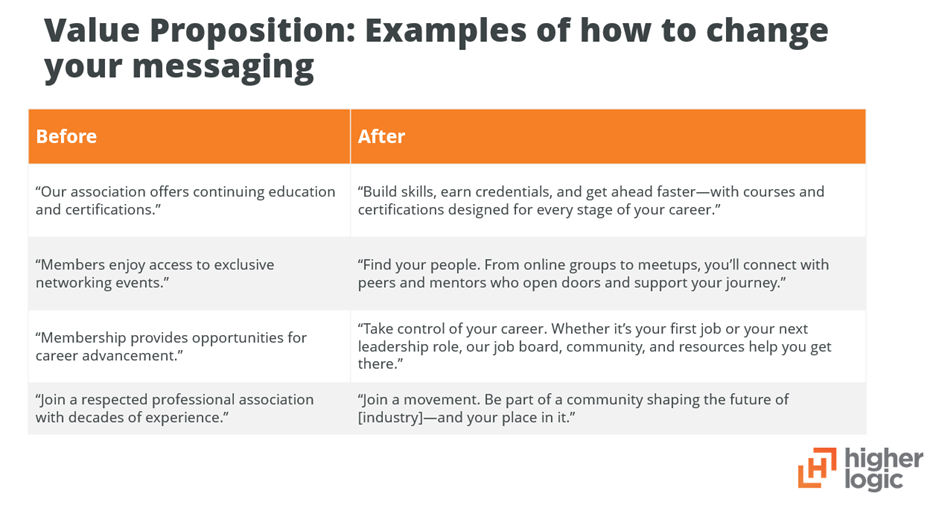
How you position value matters to. Many associations (and, frankly, even good marketers) can fall into the trap of just listing benefits and expecting people to naturally infer the value:
- Conferences
- Certifications
- Webinars
- Online communities
But members don’t join for “a conference.” They join for the impact membership will have. They’re looking for career advancement, problem-solving, protection, and connection.
An effective association value proposition focuses on outcomes.
Instead of:
“We offer a certification program.”
Clarify:
“What changes in a member’s career because they complete this certification?”
Outcome-based messaging requires deeper thinking. It forces associations to define:
- What problems members are trying to solve
- What progress they want to make
- What risks they’re trying to mitigate
- What aspirations they’re pursuing
It also requires clarity around the “how.” Trust increases when associations explain not just what they offer, but how it leads to measurable or observable improvement.
This shift — from benefit inventory to outcome clarity — is where many organizations experience the greatest impact. Here’s an example of shifting value proposition messaging (from our 2026 Association Trends and Predictions webinar):
Internal Enablement: Aligning the Whole Organization Around Value
Once an association defines their value proposition clearly, it’s important to connect that to daily conversations and strategy, not just leave it to “collect dust” in a slide deck or strategic plan.
When education teams, membership staff, sales representatives (if you have them), and volunteer leaders all describe value differently, prospects and members might not consciously notice, but they’re also not walking away with a clear sense of why the association matters.
Creating shared documentation — outlining pain points, audience segments, outcomes, and differentiators — can dramatically improve alignment. Consistency builds credibility. Credibility builds trust. Trust drives renewals.
Start Small: A Practical Framework to Strengthen Your Association Value Proposition
For associations wondering where to begin, the answer isn’t a massive rebrand. It’s clarity.
Start by defining:
- Who are you talking to?
- What pain points do they face today?
- Why are you uniquely positioned to help?
- How do you deliver that outcome?
Then validate your assumptions. Sarah suggested, “Dig into your data: dig into feedback you’ve gotten from events or in membership surveys. I also regularly do what I call a “listening tour” where I talk with people throughout the organization who work with members regularly to learn what they’ve heard.”
Data isn’t limited to surveys, it’s likely a living part of your organization. It includes:
- Online community discussions
- Event Q&A themes
- Renewal conversations
- Member testimonials
- Committee feedback
If it feels overwhelming, remember to take it one step at a time. Sarah and I joked on the episode that when you first create documentation for your value proposition and messaging plan, it can feel like your “baby” because a lot goes into that. But the good news is, you don’t have to just pop out a fully fledged “adult” all at once (lol). Get started with a “baby” version and mature it over time.
A documented, imperfect value framework is better than not outlining or talking about your value proposition at all.

Authenticity, Transparency, and Modern Expectations
One thing I made a point of mentioning on the episode too, was to encourage associations to lean into authenticity and transparency with your members. What you bring to the table doesn’t have to be perfect as much as it should really feel real, human, and relatable.
Yes, associations often guide people in an industry toward the most trustworthy resources and information. But they’re also a “professional home” where people can feel like other members and the organizations “get” what they’re going through.
In practice, reinforcing that feeling might look like:
- Leaders responding quickly and honestly sharing their thoughts on industry legislation
- Transparent explanations of strategic decisions
- Open acknowledgment of evolving challenges
- Demonstrating how programs are built and improved
- Making time and space (for example, in an online community or event) for people to just share their reality
Transparency and authenticity doesn’t mean you have to abandon professionalism, but remember to lean into openness when you can and lead with real examples and human context.
What Association Leaders Should Consider for Value Proposition
A strong association value proposition is not a marketing tagline. It is an operational discipline.
It requires:
- Clear audience definition
- Outcome-focused messaging
- Lifecycle alignment
- Cross-department consistency
- Ongoing validation through data and dialogue
And that value is not established once at recruitment. It must be reinforced continuously.
When associations regularly revisit their messaging, align teams around shared language, and clarify outcomes instead of listing benefits, they position themselves to remain relevant, even as technology and generational expectations evolve.
Associations exist to advance industries and professions. When that impact is articulated clearly, growth becomes far more attainable.
Listen to the full episode for more on how to improve your association’s value proposition.